
By Jimmy Leonard, PharmD, DABAT
National and local data have identified a spike in nitrous oxide abuse, and the growing body of evidence suggests patients may have both acute and chronic issues. Early recognition and intervention are crucial.
History and Current Use
Nitrous oxide has been used in medicine for over 180 years. It was initially demonstrated to help reduce pain during dental extractions. Later (but still early) use involved mixed oxygen and nitrous oxide self-administration to treat pain associated with labor.
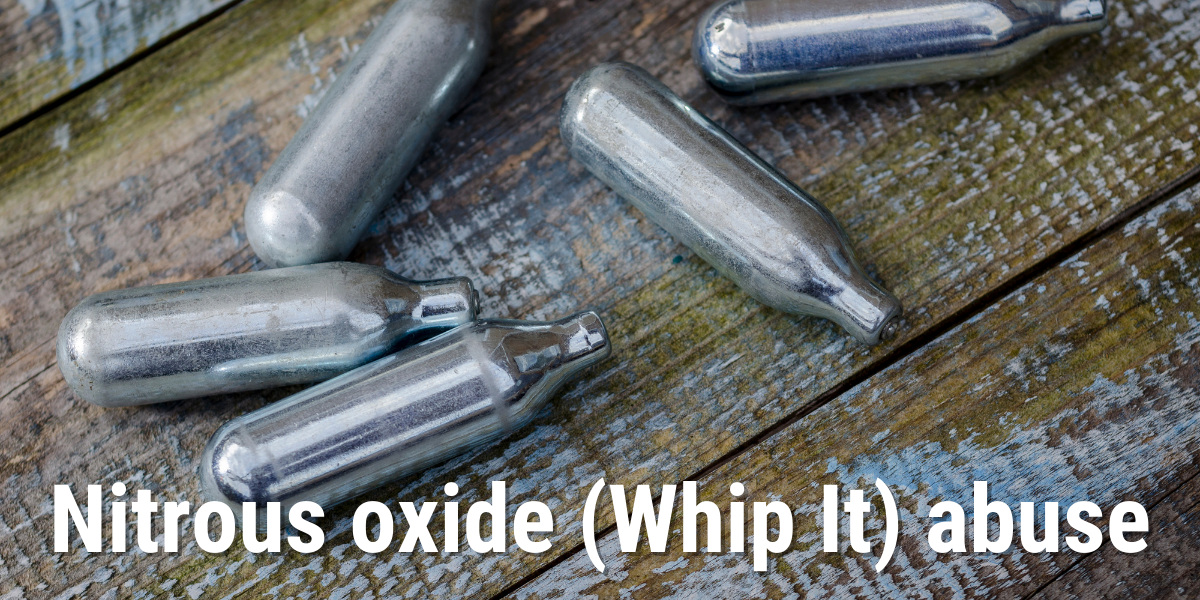
Nitrous is now sold in many stores and online. It is the propellant used to make whipped cream (thus the name “Whip Its”). Sources online sell small, metal 8 g chargers for professional whipped cream dispensers as well as large tanks containing several liters of nitrous oxide to serve as dispensers for balloons. These large tanks come with adapters intended to release nitrous oxide directly into the air. An additional recent development is that companies have begun flavoring nitrous in these large containers (with flavors such as blueberry mango, cookies and cream, and watermelon lemonade).
Nitrous oxide is NMDA receptor antagonist which causes a dissociative-like state with visual and auditory hallucinations (Wang, 2025). The euphoric effects from a single use are short acting (typically lasting only a couple minutes), requiring frequent repeated use to sustain the euphoria. The effects may differ between a single use, causing a floaty effect vs. prolonged use, causing more dissociative effects and hallucinations. Many users also report a “whooshing” or “wah-wah” sound during a session.
Several recent publications and alerts have described an increase in calls to poison centers regarding nitrous oxide. In a recent Morbidity and Mortality Weekly Report, authors from the Michigan Department of Health and Michigan Poison Center highlighted a five-fold increase in poison center cases, ED visits, and emergency medical service responses for nitrous oxide misuse from 2019 to 2023 (Vohra, 2025). International publications suggest an increase in last-year use (Zaloum, 2025).
Toxicity
Unfortunately, and unrelated to its euphoric effects, nitrous oxide is capable of significant toxicity when used chronically. Chronic nitrous oxide use leads to a depletion of biologically active cobalamin (vitamin B12) via reduction of the cobalt center of vitamin B12. In normal physiology, vitamin B12 functions as a coenzyme for methionine synthase, which is crucial in the production of DNA, RNA, myelin, and catecholamines. As a result of myelination issues, chronic use of nitrous oxide is associated with both motor and sensory neuropathies. The most commonly reported symptoms include tingling of the hands and feet, resulting in gait disturbances with continued use. In some cases we have been involved with, the chief presenting complaint to the primary care provider or emergency department was “a fall” or “difficulty walking.”
Vitamin B12 is also important for the development of normal red blood cells, and a functional vitamin B12 deficiency may cause a megaloblastic anemia. We generally recommend a complete blood count with differential for patients who report nitrous oxide huffing. An adverse effect more recently associated with nitrous oxide is venous thromboembolism (VTE). Current literature describes VTEs in people without usual risk factors. These cases describe deep vein thrombosis, pulmonary emboli, and cerebral venous thrombosis. Some patients with confirmed cerebral venous thrombosis were young (16-30 years old) and reported chronic use for only weeks prior to their symptom development (Doukhi, 2025).
Clinical Presentation
Due to the short duration of action, most patients do not show up acutely intoxicated/euphoric. Removal of the offending agent (nitrous oxide) will result in rapid resolution of euphoria/CNS depression symptoms, typically in just minutes. However, patients who show up with significant tingling, weakness, and gait disturbance may require significant vitamin B12 supplementation, physical therapy, and sustained abstinence from nitrous oxide to achieve improvement in their symptoms. Patients may also present with signs and symptoms of VTE.
Work-up
As previously mentioned, a complete blood count with differential is important to identify megaloblastic anemia or evidence of myelosuppression.
We also recommend drawing a B12 concentration, plasma homocysteine, and plasma methylmalonic acid (MMA). It is important to note that laboratory testing for vitamin B12 does not differentiate between active and inactivated vitamin B12. Vitamin B12 concentrations may be normal or even come back elevated! Vitamin B12 deficiency is a well-known enough issue in the nitrous-using community that patients who chronically use nitrous may take daily vitamin B12 supplements (Gernez, 2023; Graves, 2025). An elevated vitamin B12 concentration will not necessarily be reflective of the functional vitamin B12 concentration, due to the inability to differentiate active vs. inactive forms via typical lab testing. Regardless, it is still recommended to collect a vitamin B12 concentration as it can be helpful when interpreting homocysteine and MMA values. Homocysteine and MMA concentrations are both expected to be elevated in patients who chronically use nitrous oxide.
Imaging is not required to diagnose nitrous oxide toxicity; however, it may be useful in ruling out other causes of significant lower extremity weakness/gait disturbance. The radiographic features of significant nitrous oxide toxicity are indistinguishable from subacute combined degeneration of the cord, as both are due to a functional deficiency of vitamin B12. Radiographs may be normal even when clinically significant weakness is present. If imaging is obtained, we recommend a total spine MRI. Brain MRI is typically unremarkable.
Treatment
Treatment is largely but not exclusively supportive. The most important aspect of treatment is cessation of future nitrous oxide use.
As symptoms are often associated with functional vitamin B12 deficiency, we recommend vitamin B12 supplementation for all patients with neurological symptoms such as walking difficulties or neuropathy, as well as for mild anemia. A European guideline recommends 1 mg of vitamin B12 IM three times per week for at least two weeks. For patients whose symptoms persist, 1 mg of oral vitamin B12 can be continued daily for 10 days, followed by 1 mg once weekly for four weeks. Improvement is assessed by evaluating the time on a 10-meter walk test (Paris, 2023).
A single injection of 30 mg IV folinic acid is recommended for patients with megaloblastic anemia (Amos, 1984; Nelson, 2019), followed by 1 mg oral folate until symptoms resolve or plateau.
If you are suspicious a patient may be using nitrous oxide, call your regional poison center at 1-800-222-1222 for evaluation and management recommendations.
References
Doukhi D, Siguret V, Vodovar D, et al. Cerebral Venous Thrombosis and Nitrous Oxide Intoxication: Report of Two Cases and Review of the Literature. Brain Behav. 2025;15(3):e70394. doi:10.1002/brb3.70394
Zaloum SA, Mair D, Paris A, et al. Tackling the growing burden of nitrous oxide-induced public health harms. Lancet Public Heal. 2025;10(3):e257-e263. doi:10.1016/s2468-2667(24)00298-6
Paris A, Lake L, Joseph A, et al. Nitrous oxide-induced subacute combined degeneration of the cord: diagnosis and treatment. Pr Neurol. 2023;23(3):222-228. doi:10.1136/pn-2022-003631
Gernez E, Lucas A, Niguet J, et al. What biological markers could be used for diagnosis and monitoring of nitrous oxide abuse? Eur J Neurol. 2024;31(3):e16188. doi:10.1111/ene.16188
Graves JL, Hafner JW. Chronic Nitrous Oxide Toxicity Despite Elevated Serum Vitamin B12 Level. Clin Pr Cases Emerg Med. 2025;0(0):134-137. doi:10.5811/cpcem.39674
Agbo SMDN, Duan X, Wang L, et al. Comparative study of subacute combined degeneration of the spinal cord due to nitrous oxide abuse and vitamin B12 deficiency. Front Immunol. 2025;16:1567541. doi:10.3389/fimmu.2025.1567541