


Our new data on transgender and nonbinary representation

We have some new research to share with you that makes our hearts very heavy. Before we dive in though, we want to remind you that we are always here for you, always ready to help. Give us a call anytime at 1-800-222-1222, text us at 206-526-2121, or chat with us online at www.wapc.org.
Now, the research. Our team reviewed poisoning and overdose cases from 2011 to 2025 to compare Washington transgender and nonbinary patients with cisgender-assumed patients. We wanted to determine trans and nonbinary patients’ representation within our overall case volume, as well as better understand why they are experiencing poisonings.
Our key findings:
We received calls about 685 transgender or nonbinary patients and 214,529 cisgender-assumed patients over the 15-year period.
| Case Counts, n (%) | Trans/Nonbinary | Controls (assumed cisgender) | |
| N = 685 | N = 214,529 | ||
| Gender | |||
| Transgender women; female controls | 275 (40.1%) | 59.3% | |
| Transgender men; male controls | 299 (43.5%) | 40.5% | |
| Transgender nonbinary | 80 (11.7%) | – | |
| Unable to determine from notes; unknown controls | 31 (4.5%) | 0.01% | |
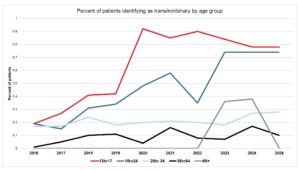
When we dug a little deeper, we found our numbers are not proportional to Washington’s estimated population percentage of transgender individuals. These folks are significantly underrepresented in our patient population, especially youth and young adults.
This is leading us to question why… Are patients not telling us that they’re trans/nonbinary? Is it incorrect documentation on our end? Mistrust or fear of our services? We have a feeling that a big factor is incorrect documentation, and we have to call ourselves out on this one. Just like any hospital or healthcare clinic, we create a medical record for every patient. Our current charting system does not have an easy way to capture if a patient identifies as trans or nonbinary. To get the data for this study, we had to manually review medical records for key words. This is a huge barrier that we’ve talked about nationally for years, but change hasn’t happened.
Our lack of change certainly doesn’t help with mistrust and fear. We know that trans and nonbinary individuals may avoid emergency services due to very valid fears of mistreatment, deadnaming, or discrimination. Clearly we need to build better trust within these communities, hold ourselves accountable, and improve our protocols so that patients feel safe calling us for help (we understand there are lots of concerns about privacy and confidentiality. Go to the bottom of this post for more info on our practices).
| 13-17 years | 18-24 years | 25-34 years | 35-64 years | 65+ years | |
| Estimated percent of state population (2023)* | 3.39% | 3.64% | 1.8% | 0.56% | 0.34% |
| Percent of WAPC patients (2023) | 0.84% | 0.74% | 0.18% | 0.07% | 0.36% |
*Data from 2023 Behavior Risk Factor Surveillance System (BRFSS) and 2023 Youth Risk Behavior Survey (YRBS)
The average age of patients in our trans/nonbinary group was 23 years, which was much younger than the average of 34 years in our cisgender-assumed patients. This fits with existing research that younger age groups are significantly more likely than older age groups to identify as transgender. However, we have to keep in mind that our data is about poisoning. So, we can also interpret this as trans/nonbinary youth and young adults are at disproportionate risk of poisoning when compared to their cisgendered peers.
To better understand what that risk is, we have to look at the reasons for our patients’ poison exposures. We found a massive disparity here: among our trans/nonbinary patients, suspected suicide/self-harm was the predominant reason. 76.9% of trans/nonbinary patients called us for help after a suspected suicide attempt, versus 17.9% of patients in the control group.
| Reason for exposure | Trans/Nonbinary | Controls | |
| N = 685 | N = 214,529 | ||
| Suspected suicide/self-harm | 76.9% | 17.9% | |
| Misuse | 1.6% | 22.6% | |
| Therapeutic error | 6.7% | 18.3% | |
| Abuse | 3.8% | 6.5% | |
This higher rate of mental health crisis isn’t inherent to being transgender on nonbinary. It’s a direct response to external stress, discrimination, exclusion, and institutional barriers. Public health research repeatedly shows that protective factors make a huge difference. Just one supportive adult, gender-affirming environment, or inclusive school/workplace can lower distress and suicide risk dramatically. Our data reaffirms that every effort we can make to build affirming relationships and spaces is literally lifesaving.
It’s completely valid to feel drained or heartbroken reading findings like these. But data is a tool that helps us name the problem, demand better care, and build stronger safety nets around the people who need them most. Data helps hold systems accountable to the people they’re serving. We at the poison center know we need to do better with our charting system and recognizing when the patients needing our help identify as trans or nonbinary.
To every trans and nonbinary person reading this: your life has value, your identity is valid, and you are not alone.
If you or someone you know needs support, please reach out to us and/or to any of these services:
- Trans Lifeline: 1-877-565-8860, https://translifeline.org/
- 988 Suicide & Crisis Lifeline: Call or text 988 (Available 24/7).
- Washington Poison Center: Call 1-800-222-1222, text 206-526-2121, or chat online at www.wapc.org
More about our medical charting and privacy practices:
Reaching out for help, especially when it involves a medication or drug, can feel scary. We want you to feel completely safe calling us, so here is an honest look at what happens when you call.
When you call us, we create a medical record. Our call center pharmacists, nurses, and doctors will ask you a series of questions, such as:
- Your name and phone number (so we can call you back if we get disconnected or if we need to check on how you’re doing)
- Your age and the medications you’re taking (so that we can give you safe, accurate medical advice tailored to your body)
- What symptoms you are having, what substance is involved, and approximately when you took it
- Your zip code and city
All that matters to us is your health. We will never request immigration status, your social security number, health insurance, or full address.
You are in control of the conversation. Everything you tell us is optional. If you aren’t comfortable sharing your name, phone number, or location, just let us know. We will still help you, no questions asked.
Your personal medical record stays confidential, just like a visit to your doctor’s office. We never sell, share, or hand over your identifiable information. We do look at anonymous, big-picture data to help keep Washington communities safe. For example, we monitor dangerous emerging substances, track regional outbreaks, and figure out which neighborhoods or communities might not know our free services exist.
Washington Poison Center is an independent, non-profit healthcare organization. We are not a government agency, and we are not connected to law enforcement, Child Protective Services (CPS), or immigration authorities. When you call us, you are talking to medical professionals whose only job is to help you.